sport auto
02/1972 (FR) – "240Z"

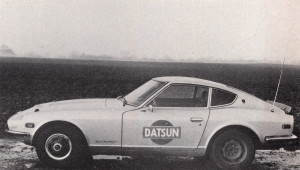
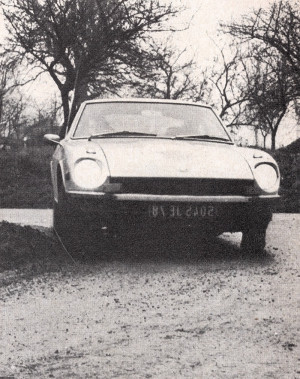
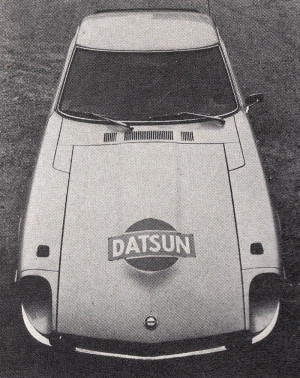
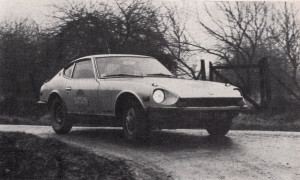
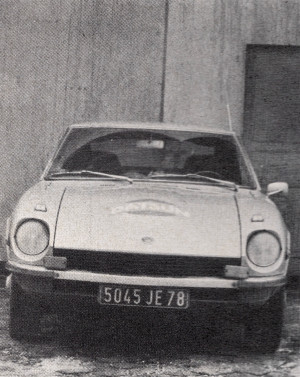
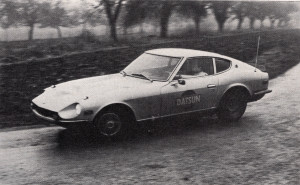
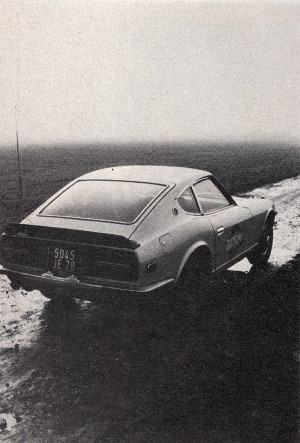
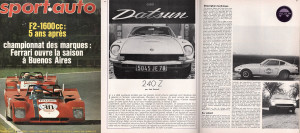
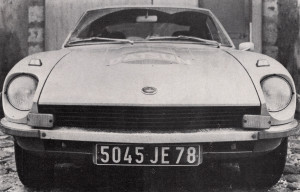
What is exciting in this article is that the car pictured represents an early test version of the export vehicles. You can see a clear mix of different parts.
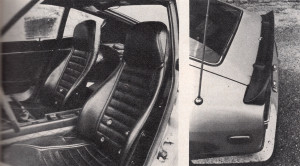
For example, the car has US side marker lights at the front and rear, but also has EU indicators on the bumper. And additional indicators on the fenders. This was seen on some very early EU test cars.

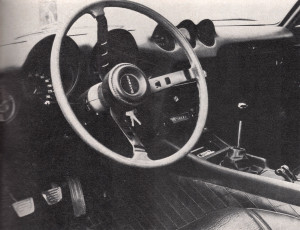
In addition, the 240Z we see here has a km/h speedometer, the rear spoiler from the Japanese Nissan Z432 and the hand throttle lever next to the choke lever.
This clearly shows that at this point in time, it had not yet been decided which options would be included in the EU export models.

(We have automatically translated the following article, which was written by José Rosinski, into English.)

Technical description

Recent Tokyo Motor Shows have provided us with photos and documentation showing and describing super-sophisticated sports models, the pinnacle of modernism, even beyond that.
However, Japanese production remains conventional in technical terms, except Honda, despite these enticing prototypes.
The Datsun 240 Z, launched in late 1969, can be described as sensibly modern.
Strictly a two-seater, it retained the principle of the engine in the rear, A strict two-seater coupé, it retained the principle of the front engine, and this engine was a 6-cylinder in-line: two perfectly conservative architectures. On the other hand, the suspension is four-wheel independent, and the timing
is by overhead camshaft, two technologies that are very much of the present day. In fact, in this respect, the 240 Z is very reminiscent of the six-cylinder Jaguar E, and we will see that this similarity is not limited to the design, but also affects the car's performance.

The body is made of steel and is self-supporting. At the front, we find a McPherson-type suspension and a sway bar, while at the rear, the coil springs and shock absorbers are concentric, forming elastic struts that are attached very high at their upper end and rest at their lower end on large transverse triangles. The steering is rack and pinion, and the power-assisted brakes combine discs at the front and drums at the rear. The wheels are steel; their rims are 4,5" wide, and they are fitted with Michelin XAS 175 14 tyres.
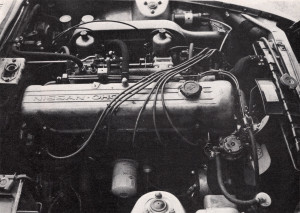
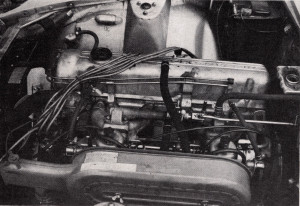
Topping the six-cylinder in-line block built in cast iron, with square dimensions (83 x 73.7 mm), the light alloy cylinder head has a single overhead camshaft distribution system; fuel is supplied by two horizontal SU carburettors.

The cylinder capacity is exactly 2393 cc, and the compression ratio is set at 9:1.

Unfortunately, the power output is only given in SAE standards: The 151 hp declared at 5600 rpm should correspond to approximately 135 DIN hp. Similarly, the maximum torque of 20.1 mkg SAE at 4400 rpm should actually be around 18 mkg.

In terms of transmission, there is a choice of two gearboxes: one with four gears and the other with five synchronised gears. The five-speed gearbox, which was fitted to our test car, is available at an extra cost of 1500 Francs including VAT. But for this price, you're not just buying an extra gear: your 240 Z will also be automatically equipped with...
tinted windows, a radio with an electric antenna and a rear window defroster! A curious combination, a strange policy...
In short, in one case, the car costs 29400 Francs including VAT, in the other, 30900 Francs including VAT.

Behind the wheel

No doubt due to the length of its bonnet, the 240 Z appears larger than it actually is. In fact, it is a very compact car, 3 cm shorter than a Porsche 911, for example. Although its lines are not excessive, it is undeniably aggressive and masculine, with a slightly massive appearance that is not at all unpleasant. In any case, it makes an impression, with the attitude of the short rear end and the spoiler added to the rear. We have not tested its effectiveness, but it certainly emphasises the rear wheels as much as the sporty character of the car.
As for the exterior appearance, we have only two criticisms: one concerns the ridiculous wheel "hubcaps", imitation light alloy, which detract from this beautiful car; the other concerns the small lights at the ends of the fenders, which seem to have been placed there to highlight the absurd situation faced by manufacturers due to the non-standardisation of regulations ...

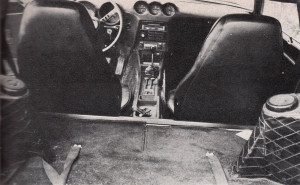
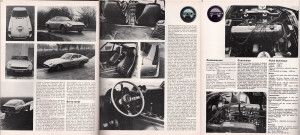
The interior is very simple and functional in style. Matt black predominates throughout, with the sole exception of the steering wheel rim, which is unfortunately made of a literally abominable "wood-effect" material. Apart from this false note, and the fact that the imitation leather is decidedly unpleasant to the touch and ugly to look at when used to upholster the seats, the layout is excellent, both practically and aesthetically.

The instrumentation is well designed and particularly comprehensive. However, only the rev counter and speedometer are directly in the driver's field of vision, while all other displays are arranged around the centre of the dashboard. The layout of the most important controls deserves high praise: the two-stage windscreen wipers, windscreen washer, headlights and indicators can all be operated at the touch of a finger without having to take your hands off the steering wheel. On the downside, however, the horn is located in the centre of the steering wheel.
Getting into the vehicle is no problem, and we particularly liked the seating position and the comfortable bucket seats. They are both comfortable and deep and feature integrated headrests, offering a remarkable balance between the demands of sporty driving and comfortable travel.
The pedals are well positioned, and the footrest for the left foot has not been forgotten either. The gear lever is exactly where it should be. The steering wheel is perhaps a little too high, but its diameter is appropriate. In short, it is obvious that a lot of care has been taken in designing this interior, which is rare enough to be worth mentioning. However, there is also a downside, namely the view, which is restricted to the front by a high belt line and to the rear by obstructive body parts and a rear window that quickly becomes obscured. The boot is sufficiently large, but it is essential to secure the load with the straps provided, otherwise it will bounce against the seat backs during the first sharp braking manoeuvre, which is very impractical.

On the road

Even though the engine warms up quickly, it does not run particularly smoothly when cold. However, in addition to the choke lever, there is an easily accessible hand throttle lever to compensate for this disadvantage. When idling, it is virtually inaudible and so well balanced that without a rev counter, it is almost impossible to tell whether it is running. The first few manoeuvres show that the extremely direct steering, with 2 2/3 turns from lock to lock, is quite stiff when stationary, but becomes pleasantly firm and impeccably precise when riding. You notice that the turning circle is very small and that the clutch travel, which is otherwise quite progressive and not too heavy, is incredibly long. The gearbox is excellent in every respect, with positive synchronisation and rather long gear ratios, which we appreciated; after all, the engine is remarkably flexible.
As speed increases, the feeling of acceleration and the ease with which the vehicle picks up speed dominate. Without using the intermediate gears, the 240 Z reveals unusual power, making it hard to believe that it is only a 2.4-litre engine. The high torque and undoubtedly very flat power curve mean that we have an enormous range of horsepower at our disposal, which is very pleasant to use. The very long gear ratios mentioned above are very well suited to this engine behaviour. If you stay in fourth gear, you can almost reach top speed, which would be absurd with a high-revving engine, but is hardly significant with this super-flexible six-cylinder engine, which offers very decent acceleration in fifth gear from 3000 rpm. Quiet, powerful at low revs and economical, as the consumption figures show, it does have one disadvantage that is common to all inline six-cylinder engines: a tendency to vibrate that is difficult to suppress. This is not really unpleasant, but in combination with a certain sluggishness, it is somewhat reminiscent of the good old days of classic cars...
The road holding of the 240 Z is extremely solid and characterised by its straight-line stability. The suspension is very soft, especially at low speeds, and proves effective in this respect; the body is very rigid and shows little tendency to roll; the steering is as direct as one could wish for and responds quickly. Overall, the balance is excellent, the directional stability is good and the handling is surprising, on one condition: when cornering at the limit, you must not let the front end skid, as it is very heavy and difficult to control. On the other hand, the Datsun readily accepts ‘swaying’, slides very cleanly from the rear and is very easy to control with the accelerator pedal – there is never a lack of power – and with the steering wheel, where you rarely have to change the position of your hands. What one might wish for is a limited-slip differential or, without going that far, wider rims to increase the rubber surface area on the road. However, this would probably further reduce the suspension comfort, which is not exceptional anyway.
In any case, this is a minor criticism. The braking system, on the other hand, gives cause for more serious concern. If you brake hard without restraint, fading and a noticeable drop in performance occur very quickly, clearly showing that the 240 Z has a weakness in this respect. This is its weak point.

Performance

At Montlhéry (France), in cold and wet weather, we achieved (intermediates pushed to 7000 rpm):
0 - 400 m: 16,7 seconds (two people on board)
0 - 1,000 m: 31,2 seconds
Maximum speed: 189,5 km/h at approximately 5600 rpm, or 195 km/h at constant speed
Maximum readings on intermediates: at 7000 rpm: 1st 65 - 2nd 115 - 3rd 165 at 6500 rpm: 4th 200 (or 185 actual)
Average fuel consumption during testing: 15 litres / 100 km.

These figures indicate good use of power. They compare favourably with the performance of an Alfa Romeo 2000 GT or a BMW 2002 Tii, for example.

Conclusion

Apart from its braking, the Datsun 240 Z compares favourably in every respect with these well-established models. It is true that it is a little more expensive and only has two seats. However, its attractive styling is a major asset, and if we accept that what happens in the United States foreshadows what will happen in Europe, the incredible number of Datsun 240 Zs on the streets of California suggests that France could soon be inundated with them too... In any case, this car has many qualities, and testing of the production model confirms the excellent rally results of the competition version of the 240 Z.

Technical specifications

Length: 4,115 m
Height: 1,26 m
Width: 1,63 m
Vehicle weight in running order: 1040 kg.
Permitted laden weight: 1220 kg.

Engine
6-cylinder in-line with overhead camshaft.
Bore: 83 mm - Stroke: 73.7 mm.
Displacement: 2,393 cm3 - Compression ratio: 91.
SAE power: 151 hp at 5,600 rpm.
Fiscal power: 14 hp.
Maximum torque: 20,1 mkg at 4400 rpm.
Maximum engine speed: 6000 rpm.

Fuel supply via two SU carburettors.
Electrical system: equipped with alternator and automatic disengageable fan.

Transmission
Hydraulically operated single dry plate clutch.
5-speed gearbox with reverse gear.
Rear-wheel drive via bevel gear ratio 3,9/1.

Suspension
Front: Independent, telescopic shock absorber in the centre of the coil spring and stabiliser torsion bar.
Rear: Independent, double-acting telescopic shock absorbers in the centre of the coil spring.

Steering
Rack and pinion - Turning circle: 9,6 m.

Braking
Hydraulic assisted, dual independent front and rear circuits with leak control on the dashboard.
Front: disc brakes.
Rear: drums and shoes.

Further interesting press articles