S30.world, a new world for the Datsun 240Z

Original article: Octane NL magazine 12/24 by Ton Roks

An unstoppable group of Datsun 240Z (and Fairlady Z) enthusiasts have joined forces and created 530. World, an ambitious project focused on promoting the 240Z, producing parts, performing top-notch restorations and - last but not least - building the ultimate S30 restomod.

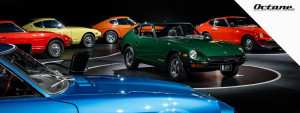
Anyone who wants to see what the men behind S30.World are capable of should visit the Visscher Museum in Buren, where the showroom is located, filled with 240Zs in all sorts of guises. There they are in the spotlight, Zs with early chassis numbers, sometimes in their first paint, most of them already restored with great care. The name S30.World is derived from Nissan's internal type designation for the 240Z, the sports coupe that put an end to British hegemony in the world of sports cars in the early 1970s and would become known in Japan as the Fairlady Z.
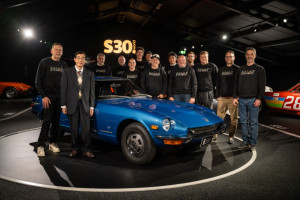
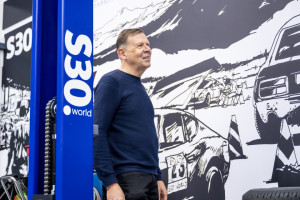
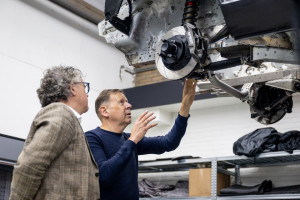
S30.World is an initiative of Chris Visscher (left in the photo) and Gustav Oplasnik (sixth from the left), both active in restoring S30s for quite some time. Visscher has been a Renault and Nissan dealer in Amsterdam and was the place to go for a Renault Sport or Nissan GTR. However, his love for Nissans has surpassed the fast Renaults, which is why he sold that collection to realize S30.World.

Gustav Oplsanik is cut from the same cloth as Chris when it comes to his love for the 240Z. He has a restoration company in Budapest and is possessed by an identical passion, striving for the same high quality as Visscher. The two have been working closely together behind the scenes for S30.World.
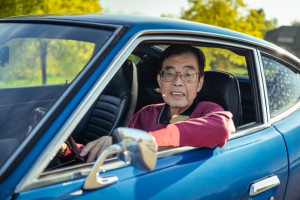
The opening took place on October 24, 55 years after the 240Z was unveiled to the general public during the Tokyo Motor Show. Takeo Miyazaki (photo above), the engineer who was intensively involved in the development of the S30 and is now the 'last man standing' who can still talk about it from personal experience, was flown in especially from Japan as guest of honor. He told his story in Buren not only to Octane, but also on camera, the result of which will be available with subtitles on the S30.World website.

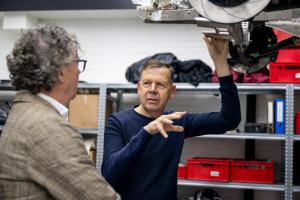
Chris Visscher (photo above) explains: “We have already restored a number of S30s to give S30.World tangible form with cars of the highest possible quality – we have now reached the point where we can also build them for other enthusiasts around the world. We have a large supply of New Old Stock Parts and quite a few project cars that are suitable as a basis for people who want a perfectly restored 240Z. Here in Buren, we can show the high standard we work to.”
He continues: “We want to do more than that. We are going to develop S30.World online into an international platform to promote the love of the S30 and share stories and knowledge with other enthusiasts. We have been preparing for this for years and like-minded people have joined us to help, from Germany, Japan, Switzerland, Great Britain and the USA. There is already a lot of information on the website, but that is just the beginning.”

The fact that S30.World has also taken on the production of parts shows that Visscher is not a man of words alone. He explains: “Some parts for the 240Z are a challenge, they are almost impossible to find. That is why we have started producing standard fuel tanks for 240Zs from the period 1969-1978. It is difficult to make the doors of a 240Z close properly, so we now make our own rubbers from exactly the same material as Nissan used to use. We have also put a lot of energy into reproducing the rubber mats that were made for the USA and Canada, and also for the Japan in the first months of the Z432. They are impossible to find. Thanks to our mats, the super early Z that we have restored, the blue HLS30-00023, is 100% exactly as it left the factory.”

“We have no intention of competing with other parts manufacturers, but if certain parts are not available or are not of good quality, we will make them. We are also developing a power steering system. We have opted for an electro-hydraulic system rather than a fully electric one because we consider it essential that the original steering feel remains intact.”

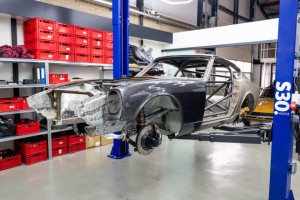
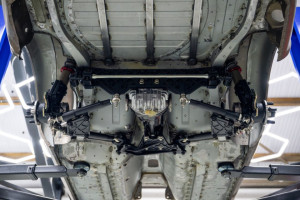
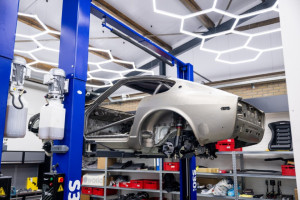
That is not all. In a corner of the Visscher Museum is a workshop where Visscher and his team are working on a 240Z restomod, not a copy of the legendary Fairlady Z432R, but a car somewhat in the spirit of that car. For the uninitiated: the Z432R is the most valuable S30. In 2021, one was sold at auction in Tokyo for 88 million yen, equivalent to $800,000 at the time. The R is a hard-core version of the Z432, stripped of all non-essential parts and developed for motorsports. It was intended for wealthy enthusiasts who wanted the fastest possible Fairlady Z for public roads. A total of about four hundred Z432s were made. They were equipped with the 2-liter inline six-cylinder engine from the Nissan Skyline 2000 GTR PGC10, the four-door sedan that caused a sensation in Japanese touring car racing. The engine configuration was reflected in the model designation: the '4' for four valves per cylinder, the '3' for the number of double carburettors and the '2' for the two overhead camshafts.

Chris Visscher does not have a hardcore street racer in mind with his still unfinished restomod. “Most restomods are very intense, fun for half an hour, but after that you soon start to get fed up with them. I don't want that. The car is a project by John Prynn, who is also on our team, and myself. We are aiming for a car that can behave as relaxed as a good Gran Turismo, but that can also reach high speeds when you want it to.”
John Prynn explains: “Under the hood will be a fully alloyed six-cylinder engine with dry sump, four valves per cylinder and injection, inspired by Nissan's RB engine, and enlarged to 3.6 liters. We are not using a turbo, the engine must be as pure as possible, and we do not want the sound to be muffled by forced induction. It will have as light a rotating part and valve train as possible so that it can handle 9,000 rpm for a long time, but with maximum driveability. You should enjoy getting in it and driving to the South of France in one go.

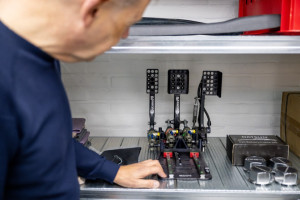
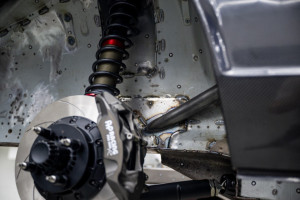
The list of upgrades is long. John Prynn: “It will be fitted with four-way adjustable dampers for trips to the racetrack; in-house developed suspension made from extra strong aerospace materials and fully adjustable for optimal wheel geometry. Air conditioning and adequate soundproofing are a must, both lightweight of course. We are also going for Watanabe alloy wheels, copies of the wheels that the factory racers drove with in Japan in the '70s. The larger brakes will be from AP Racing, and of course we will also install an adjustable AP Pedal Box. You can also count on traction control and a transmission with the lightest possible components. We are aiming for the lightest car possible.”

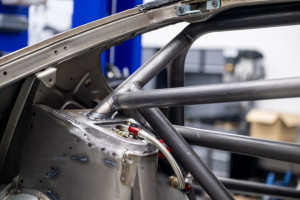
Chris finishes the story: “The bodywork will of course be reinforced and will have an integrated roll cage, which means we can position the seats a little deeper and further back so that taller people can also sit comfortably. We will compensate for the weight we add through our reinforcements by making the roof, front fenders, hood and tailgate out of carbon. We will leave the doors as they are. I don't want it to sound cheap when you close them. You can count on it being fun from the very first minute and always will be. That's what we're going for.”

The car will be called the S30 ZERO. Why that name? “It is something completely new, a combination of all S30 styles from the years 1969-1978, and the first of what will probably be a new series. For us, it is primarily a very cool project and a beautiful design. I first wanted to know literally everything about those cars, down to the last screw. Only after we had restored eight S30s to perfection did I feel that we were ready to build a car like the S30 ZERO and had enough knowledge to be able to stay very close to the original design.”

Text: Ton Roks / Photography: Luuk van Kaathoven

We have even more exciting news for you: