
History
#240Z #260Z #280Z
Florian Steinl Florian Steinl
06.05.2026

Datsun 240Z to 280Z - a beginner's guide

This is intended as a guide for newcomers to the S30 series.
Although the Zs hardly changed in appearance between 1969 and 1978, they were given different names depending on the year and country.
For example, there is a Datsun 240Z and a Datsun 260Z for all export markets. The Datsun 280Z, on the other hand, was only available in North America. In Japan, there are also the Nissan Fairlady Z models.
At first glance, this is quite complicated, and it’s easy to lose track of things.

So, to make it easier for you to get started in the world of these beautiful cars, we have tried to provide a brief and simplified overview of the main differences.

To begin with, here is a timeline to help you better understand the vehicles within the context of their evolution.

Japan:
End of 1969 to 1975 – Nissan Fairlady Z S30, L20 / 2.0l engine (L24 and S20 engines were only very rarely found in the Nissan Fairlady 240Z(G) and Nissan Fairlady Z432(R) – but that is not the focus of this beginners’ guide)
1975t to 1978 Nissan Fairlady Z S31, L20 / 2.0l engine

USA:
Late 1969 to late 1973 – Datsun 240Z, L24 / 2.4l engine
Late 1973 to Late 1974 Datsun 260Z, L26 / 2.6l engine
Late 1974 to 1978 Datsun 280Z, L28 / 2.8l engine

Europe and other parts of the world:
Early 1971 to Late 1973 – Datsun 240Z, L24 / 2.4l engine
Late 1973 to 1978 – Datsun 260Z, L26 / 2.4l engine
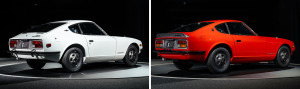
As well as the obvious differences in the engines – which is why the models are named as they are – there are other immediately recognisable features that allow you to tell straight away which model it is.
We have decided not to include the Japanese models here so as not to overcomplicate this fairly simple guide, but we will publish a further, more detailed article on the individual model differences in the future.

In these two photos, you can see an early Datsun 240Z from the USA and a late Datsun 240Z from Europe.
But how can you tell them apart? We’ll therefore briefly outline the differences here:

– Rear spoiler: This spoiler was developed specifically for the EU models and was not available as standard equipment in the USA.
– Hubcaps: The hubcaps on the early Datsun 240Z differ from those on later model years of the Datsun 240Z.
– Side indicators: The US models had side marker lights at both the front and rear. Vehicles not built for the US market only had front side indicators. However, there were also export markets where there were no side lights at all.
– Incidentally, the fuel cap was not lockable for the US market.

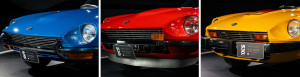
You can also spot lots of little details at the front.
For example, the Datsun 240Zs for North America had additional horns on the bumpers, whereas those for the EU markets (the picture in the middle) did not.
You can also tell the EU cars apart by the fact that they had a front spoiler and the indicators are not mounted below the bumper but are bolted on top.

Incidentally, the EU 260Zs look the same. And this remained the case right up until 1978.
On the right of the picture we see a late Datsun 280Z from the US. Here too, the bumper has changed (pedestrian protection, 5mph rule) and the front indicators have also been moved into the grille.

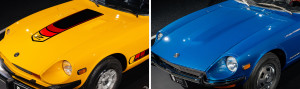
Another interesting change found on later Datsun 280Zs can be seen here: the hood has two air vents.
Early 280Zs didn’t have these, by the way, and looked like the blue Datsun 240Z on the right.

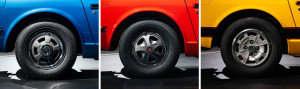
Hubcaps have also changed over the years.
Early 240Z models feature so-called Type A hubcaps; later 240Z models and the 260Z are equipped with Type B hubcaps, whilst the 280Z has Type C hubcaps fitted.
By the way, Type A and Type B hubcaps are made of metal.

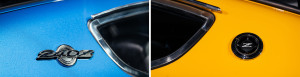
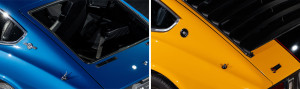
If you look at a Z from the rear at an angle, you’ll immediately notice that the badge on the C-pillar has been changed.
The early 240Z models had a "240Z" badge mounted here. You’ll also find small air vents on the tailgate.
The two features are closely linked, as the change of badge meant the small vents were removed.
The new emblems now served the same function as the previous openings in the tailgate: air can now escape when the doors are closed.
Furthermore, fewer exhaust fumes now enter the cabin and less water gets into the boot when it rains.

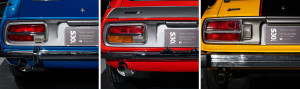
Moving a little further back, we can see that there have been quite a few changes here too.
On the left side of the picture, we can see a very early US 240Z. Just like at the front, this one has horns on the bumper and red rear lights.

Incidentally, we also notice something very special on the red EU 240Z: the number plate was illuminated from below by two very prominent lamps. Furthermore, just like at the front, the car has a rear spoiler developed specifically for the EU market.
The badges are therefore not mounted on the tailgate, but on the spoiler.
There are no bumper horns here. On the other hand, the indicators were orange – as they were in Japan.

From the end of 1973, a lot changed. The 260Zs were equipped with larger rear lights, which were also adopted on the 280Z. On which, the rear bumper was made significantly larger, mirroring the front bumper.

If you look closely, you can also see that the exhaust outlet has changed. This was also made smaller following the model change at the end of 1973. This was because the large outlet with the twin exhaust pipes was related to the Nissan Z432 in Japan.

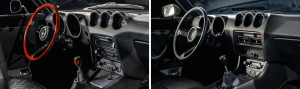
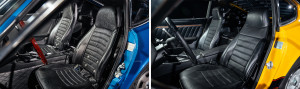
Inside, there are also many differences when comparing models from different years.
For example, the Datsun 240Z still has a steering wheel with a wood-fibre ring, while the 260Z and 280Z has a vinyl steering wheel. The horn button has also been enlarged.

The seat covers have also changed significantly, as have the door panels, which differed markedly from late 1973 onwards with the introduction of the Datsun 260Z.

If you take a close look at the dashboard, you will notice that this too changed significantly in late 1973 and remained the same in the 260Z and 280Z models.

Further changes include the carpet, the centre console and many small details, such as controls and instruments.

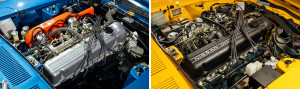
The most obvious difference between the three models is undoubtedly the engine and its displacement.
However, the fuel injection system in the Datsun 280Z also made it clear that this was the most modern version.

The Datsun 260Z, by the way, still had carburettors installed in all export markets, which differed slightly in design from those of the Datsun 240Z.

Summary: We hope that this brief and concise overview of the different changes will help you to distinguish between individual models.

Of course, we know that there are typically 5–8 variants of each part. However, we intend to cover this variety in separate articles.

It is important to understand that the evolutionary development of the S30 series was constantly evolving and was influenced by various factors.
At times, the focus was on improving production processes; at others, it was on making the cars more stable or reliable.
At other times, the aim was to comply with stricter regulations in export markets.
Some of these changes therefore also affected vehicles produced for other countries. Other changes were implemented for only a very short time and for a very small target group.

You can find more exciting articles here